
FORT PURBROOK AND FORT WIDLEY ARE NOW BOTH ON THE AT RISK REGISTER!


Heritage at Risk
Fort Purbrook and Fort Widley on top of Portsdown Hill are Grade Two Star Listed Buildings and Scheduled Monuments. PRIORITY CATEGORY – C
Fort Purbrook was placed on the Historic England Heritage at Risk Register in October 2016. Sadly Fort Widley has today also been placed on the register. The Heritage at Risk Register is designed to attract conservation funding to important buildings and sites.
The safety of the customers and staff of Peter Ashley Activity Centres Trust (PAACT) is paramount to the charity and, although we have no mandate to conserve the forts, we recently appointed a Health and Safety Manager to ensure that visitors are kept safe. Additionally, we commissioned a survey in Fort Widley to help us identify major problems. From this, urgent issues have already been addressed and work has commenced on rectifying longer term problems. Full structural surveys of both forts are planned soon as mentioned below.
Listing Definition - SCHEDULED MONUMENTS
Scheduled monuments include single archaeological sites and complex archaeological landscapes. Nearly 20,000 examples have been listed because of their national importance. Scheduled monuments are not graded. They cover human activity from the Paleolithic era, such as cave sites, to 20th century military and industrial remains.
For the millennia before written history, archaeology is the only testament to innumerable generations of people of whom there is no other record. The later 20th century saw unprecedented changes to the landscape. As a result, some types of historic sites that once were commonplace began to become rare. Those that survive often represent just small islands of what once characterised broad sweeps of our towns and countryside.
Although protected by law, scheduled monuments are still at risk from a wide range of processes and intense pressures outside of the planning system. These include damage from cultivation, forestry and, often most seriously of all, wholly natural processes such as scrub growth, animal burrowing and coastal erosion. Scheduling is discretionary, and many archaeological sites of potential importance are not scheduled. Instead, they are managed through the planning system and other regimes.
Listing Definition - LISTED BUILDINGS
Listing is the most commonly encountered type of statutory protection of heritage assets. A listed building (or structure) is one that has been granted protection as being of special architectural or historic interest. The older and rarer a building is, the more likely it is to be listed. Buildings less than 30 years old are listed only if they are of very high quality and under threat. Listing is mandatory: if special interest is believed to be present, then the Department for Digital, Culture, Media and Sport has a duty to add the building to the List.
Listed buildings are graded I, II* and II. Grade I buildings are of outstanding interest, and II* are particularly important buildings of more than special interest; together they amount to 8% of all listed buildings. The remaining 92% are of special interest and are listed grade II. Entries on this Register reflect how buildings are grouped and recorded on the statutory List.
Structures can occasionally have dual List entries (be both listed as buildings and scheduled as monuments). In such cases, scheduling controls take precedence.
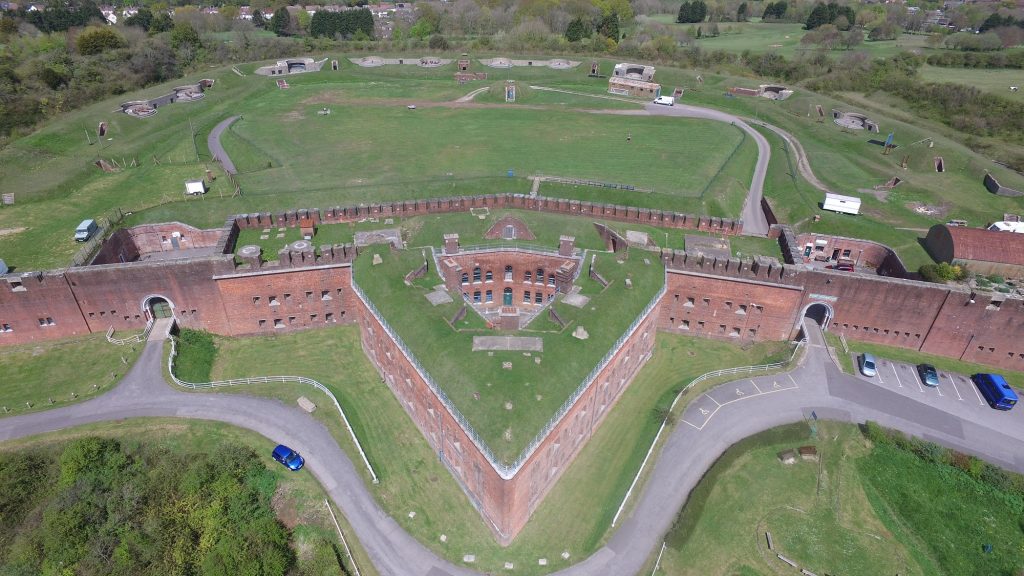
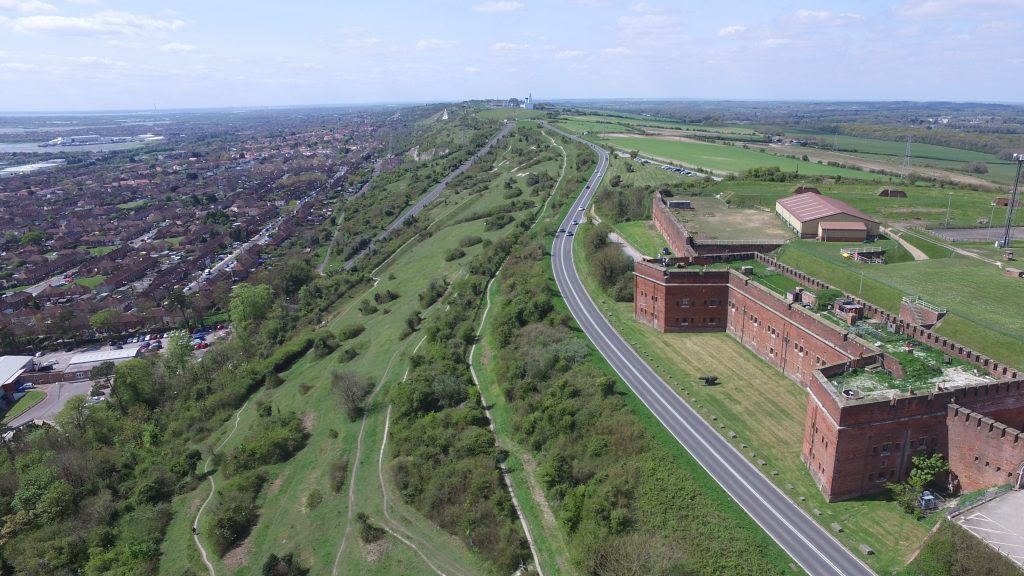
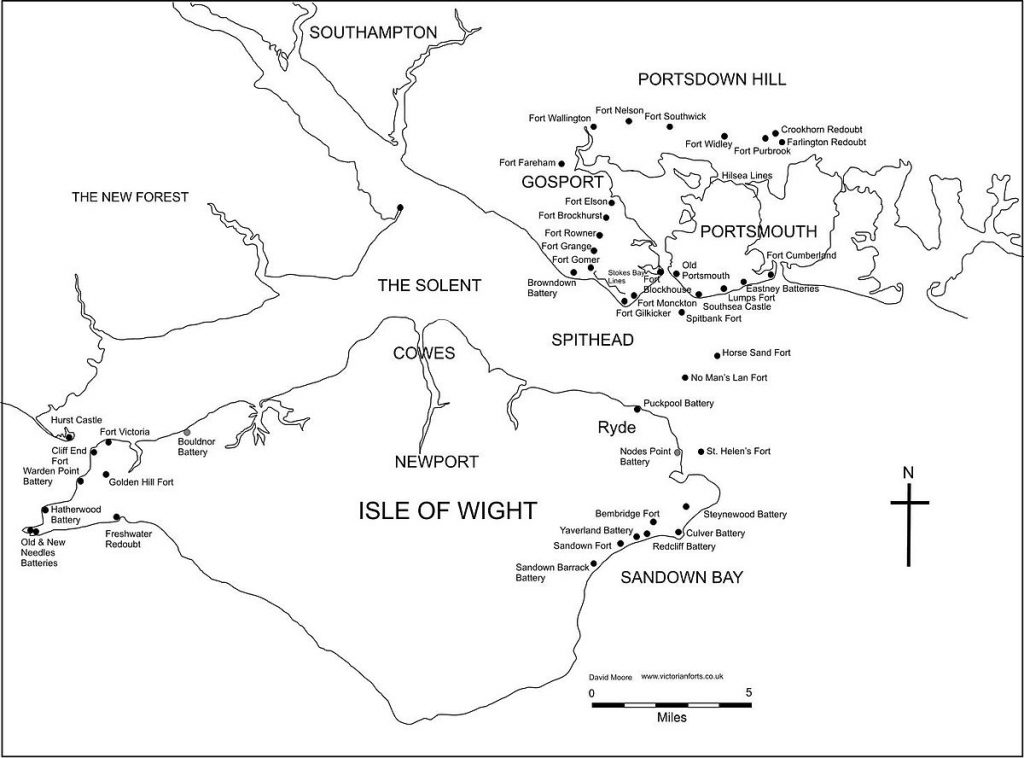
The Forts are part of the defensive ring built in the 1870s to defend Portsmouth Dockyard from attack by an invading French army. The Forts were sanctioned by Lord Palmerston who realised that recent engineering developments put the Royal Navy at risk for the first time in over a century of dominance at sea. He saw that the newly developed steam powered ships could cross the Channel and land a large army somewhere on an otherwise unfortified part of the coast before the Royal Navy could intervene. Then, marching along the coast, they could occupy Portsdown Hill and shell the Dockyard using the newly invented rifled guns that had a far greater range than earlier smooth bore cannon.
As the Nuclear Deterrent of their day and with the help of some strategic publicity the Forts achieved the aim of deterring a French invasion.
Nearly one hundred and fifty years on, the Forts that also saw service in two World Wars are showing their age. Owned by Portsmouth City Council (PCC) they are thus OUR Forts. Leased since the 1980s to PAACT they are home to a wide range of outdoor and indoor sporting activities for the people of the area, especially those who are disadvantaged by income or needs.
Constrained by government funding cuts and other priorities PCC, as owners, are not able to release the funding or resources to solve the problems of conservation, repair, and maintenance. Despite PAACT having worked tirelessly over the past thirty years to restore and bring back in to use many areas of our Forts. The charity, which provide learning, sport, and fun for all, is unable to access the high level of funding required for structural repairs as they do not own the Forts.
But there is good news!
PCC is now in discussion with PAACT to form a partnership bidding for grant funding of conservation, and repairs. Once agreement is reached, PAACT plans to take on responsibility from the council for identifying sources of funding, defining packages of conservation work, preparing, and writing bids as well as funding this initial work. Thus the partnership will be able to make application to such bodies as the Heritage Lottery Fund and Historic England for the conservation of our Forts.
Application is already in hand to achieve grant funding for two urgent projects at Fort Purbrook, the repair of five footbridges that access the main barrack building (The Redan) and the repair of a collapsed retaining wall in the moat. It is expected that full structural surveys of the Forts will identify ongoing maintenance plans for the forts to ensure they remain in use into the future.
A further bid is underway to gain funding for a project at Fort Widley that will refurbish the reception and establish a café area as well as carrying out urgent structural work on the Redan. This will enable guided tours of the Cold War Civil Defence Command Centre that has long been a hidden secret within Fort Widley.
Watch this space for regular updates and news of more exciting developments in and around Fort Purbrook and Fort Widley as we move towards a conservation plan for their use by the community.
If you would like to see the full register then please follow the link below
https://content.historicengland.org.uk/images-books/publications/har-2017-registers/se-har-register2017.pdf/



For more information or to contact someone please see the details below
Clare Charlesworth, Historic England South East
Eastgate Court, 195-205 High Street,
Guildford, GU1 3EH
Telephone: 01483 252 020
Email: southeast@HistoricEngland.org.uk
Twitter: @HE_SouthEast



Darren Bridgman, Operations Director PAACT
Fort Purbrook, Peter Ashley Lane,
Portsmouth, PO6 1BJ
Telephone: 02392 321 223
Email: darren@peterashleyactivitycentres.co.uk
Twitter: @PeterAshleyAct